
Clinical Breast Examination (CBE)
A Clinical Breast Examination (CBE) is performed by a surgeon or qualified healthcare professional through careful physical examination of the breasts and underarm (axillary) lymph nodes.
Purpose
To identify potential abnormalities, including:
- Breast lumps or masses
- Enlarged lymph nodes in the armpit
- Nipple discharge
- Skin dimpling or retraction
- Breast redness or swelling
- Other signs that may require further investigation

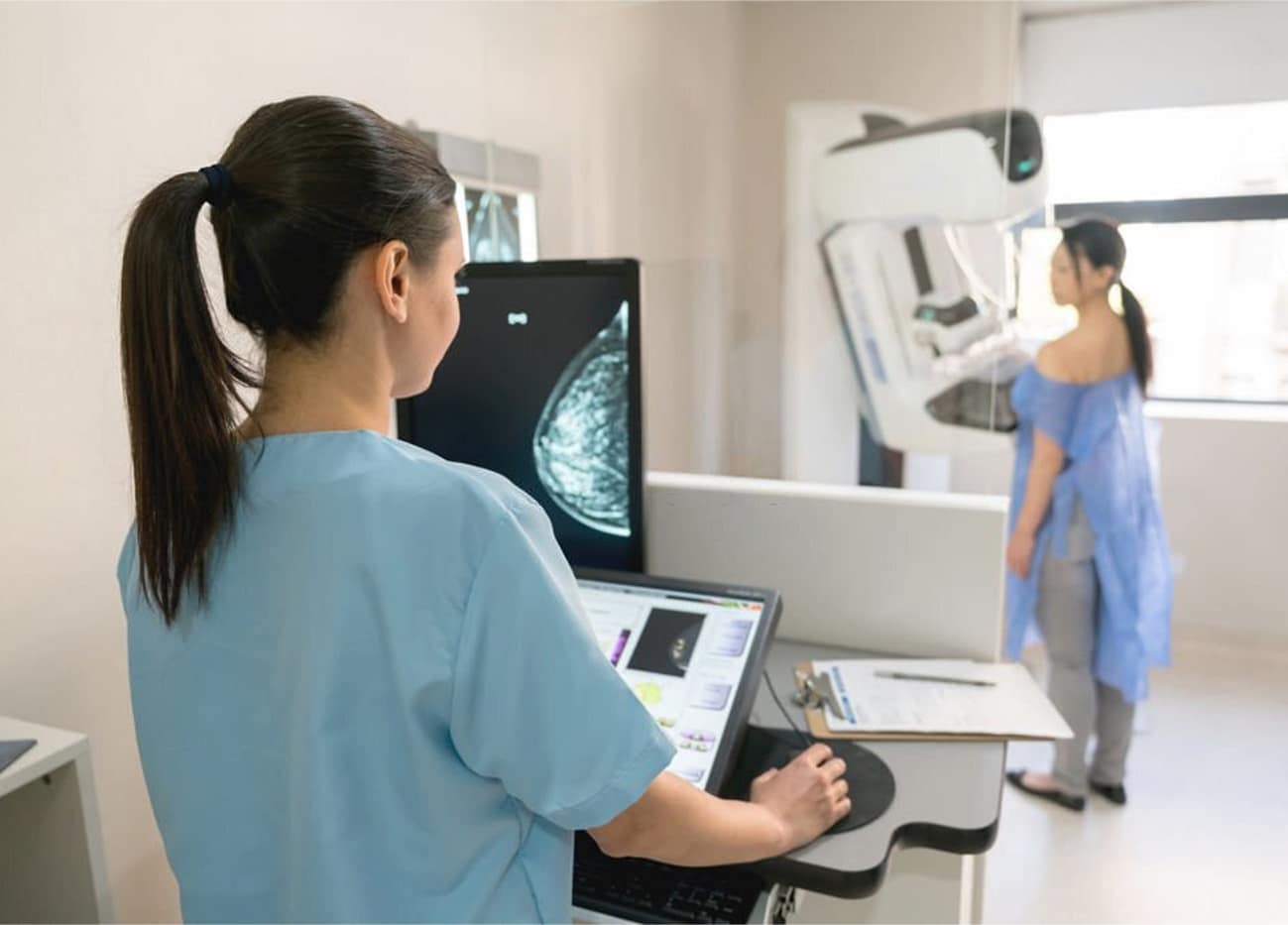
Mammography
Principle
Mammography uses low-dose X-rays to produce detailed images of breast tissue.
Advantages
- The most effective screening tool for detecting microcalcifications, which may be an early sign of breast cancer.
- Capable of identifying breast abnormalities before they become palpable.
- Proven to improve early detection and treatment outcomes.
Recommended For
- Women aged 40 years and above
- Women with a family history of breast cancer or other risk factors
- Individuals advised by their healthcare provider to undergo regular breast screening
Breast Ultrasound
Principle
Breast ultrasound uses high-frequency sound waves to create images of breast tissue.
Advantages
- Particularly suitable for women with dense breast tissue, which is common among Asian women.
- Helps distinguish between:
- Fluid-filled cysts
- Solid breast masses or tumours
- Can complement mammography for a more comprehensive assessment.
Limitations
- Less sensitive in detecting microcalcifications compared to mammography.


Breast MRI (Magnetic Resonance Imaging)
Principle
Breast MRI uses a powerful magnetic field and radiofrequency waves to generate highly detailed cross-sectional images of the breasts without exposing patients to ionising radiation.
For optimal accuracy, a contrast agent is usually administered intravenously during the examination.
Advantages
- Highly sensitive for detecting early-stage breast cancer
- Effective in identifying multiple lesions within the breast
- Particularly beneficial for:
- Women with dense breast tissue
- Patients with breast implants
- Individuals at high risk of breast cancer
- Provides detailed imaging when mammography or ultrasound findings are inconclusive
Limitations
- Higher cost compared to other breast imaging modalities
- Small risk of allergic reaction to the contrast agent
- Not suitable for patients with certain implanted magnetic or metallic devices